AI Case Notes
This project is currently in development. I'm happy to walk through the full research and design details in a conversation.
Enter the access password, or reach out to request access.
Incorrect password. Try again or get in touch.
AI Case Notes — Making Every Educator Ready to Teach
I helped design an AI tool that generates custom teaching notes for Harvard Business cases — and within weeks of launch, 85% of users said it saved them time.
The Problem
"Advance efforts to offer AI-powered teaching and learning support in ways that mitigate intellectual property risks, unlock new revenue, and create differentiation."
Teaching business cases well takes serious preparation. Educators need teaching notes — structured guides that walk them through the case's key concepts, discussion questions, and pedagogical goals — but those notes rarely account for each educator's specific course context, level, or teaching style.
The result is a preparation process that can take hours, especially for cases that don't have existing notes at all. And the gap was significant: Most cases in HBP's catalog had no teaching note at all. For those that did, quality varied enormously.
The question we set out to answer: what would AI-powered teaching support need to look like to actually reduce that burden — without feeling generic or losing the rigor that HBP's faculty audience demands?
Discovery
Understanding how educators actually prepare
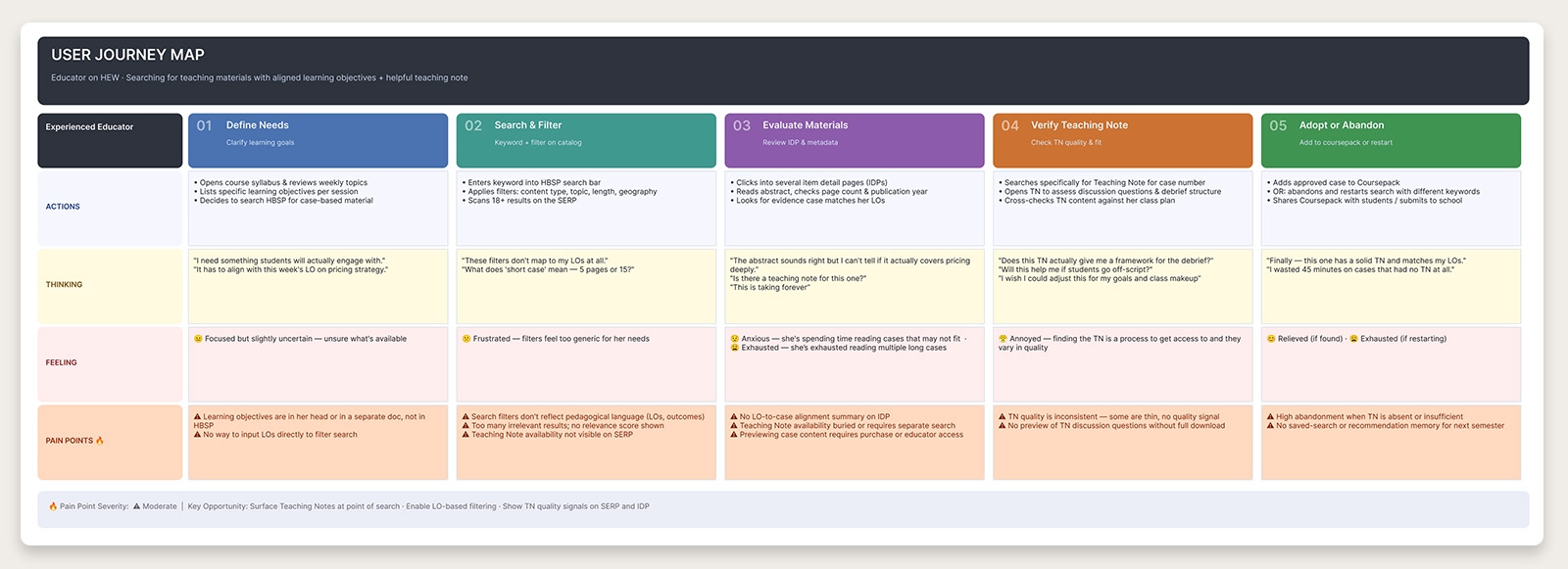
I came into this project in the early discovery phase, leading research on how educators prepare to teach business cases. I wasn't starting with a product concept — I was starting with genuine curiosity about the workflow. What does an educator do in the week before class? Where do they go? What's frustrating? What feels irreplaceable?
Through interviews and synthesis, we mapped the current preparation journey and identified the real friction points: it wasn't that teaching notes didn't exist — it was that existing notes rarely matched what a specific educator needed for a specific course. And for most cases in the catalog, there were no notes at all.
Defining what AI support should feel like
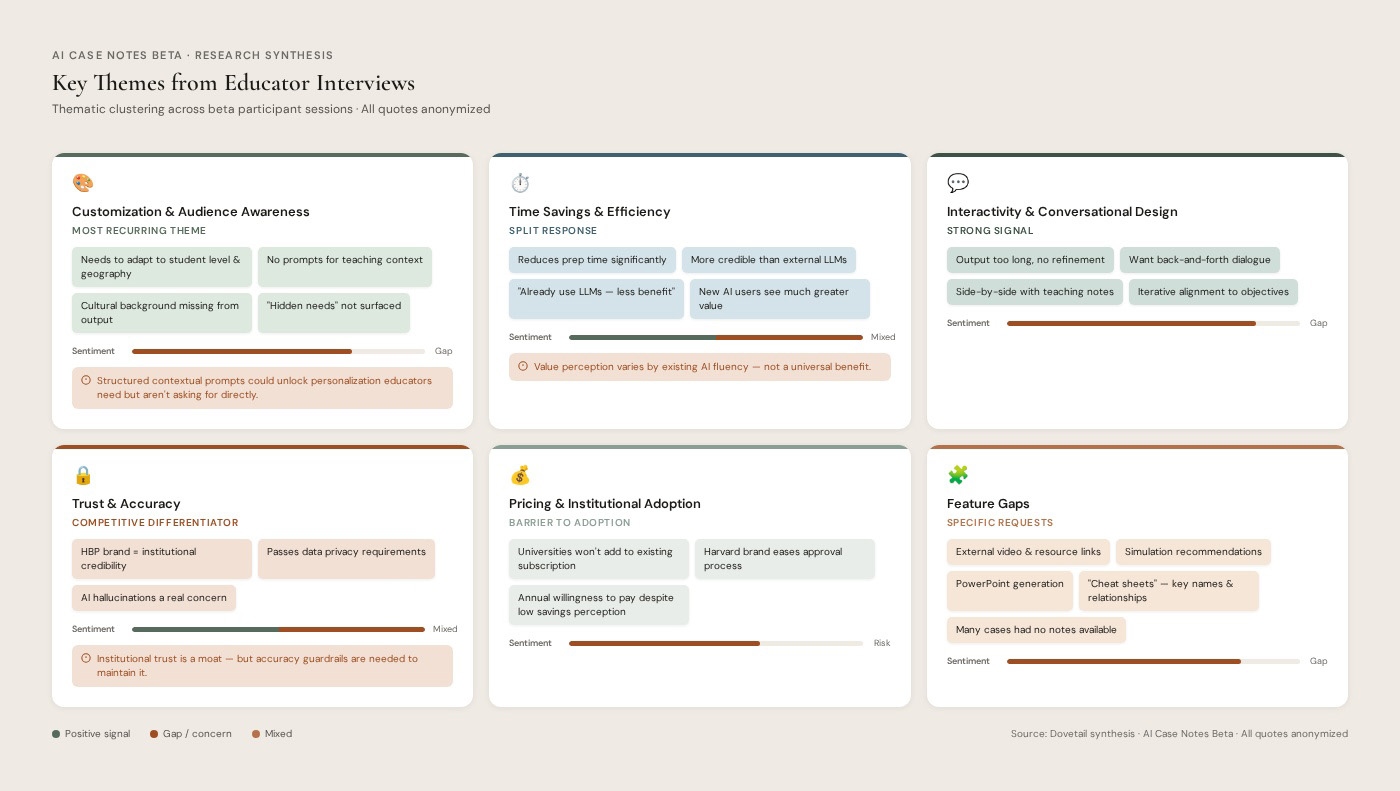
Once we understood the workflow, my focus shifted to defining what AI support should feel like in this context. For busy academics, it needed to feel rigorous, not generic. It needed to feel like a knowledgeable colleague had done the synthesis work for you, not like a chatbot filling in a template. That framing shaped everything from the AI model requirements I helped define to the level of guidance built into the interface.
"It needed to feel like a knowledgeable colleague had done the synthesis work for you — not like a chatbot filling in a template."
These insights directly informed three product dimensions: the beta design on the website, the AI model requirements, and the degree of guidance built into the user interface — particularly important given the wide range of AI familiarity among educators.
Design
Translating research into design decisions
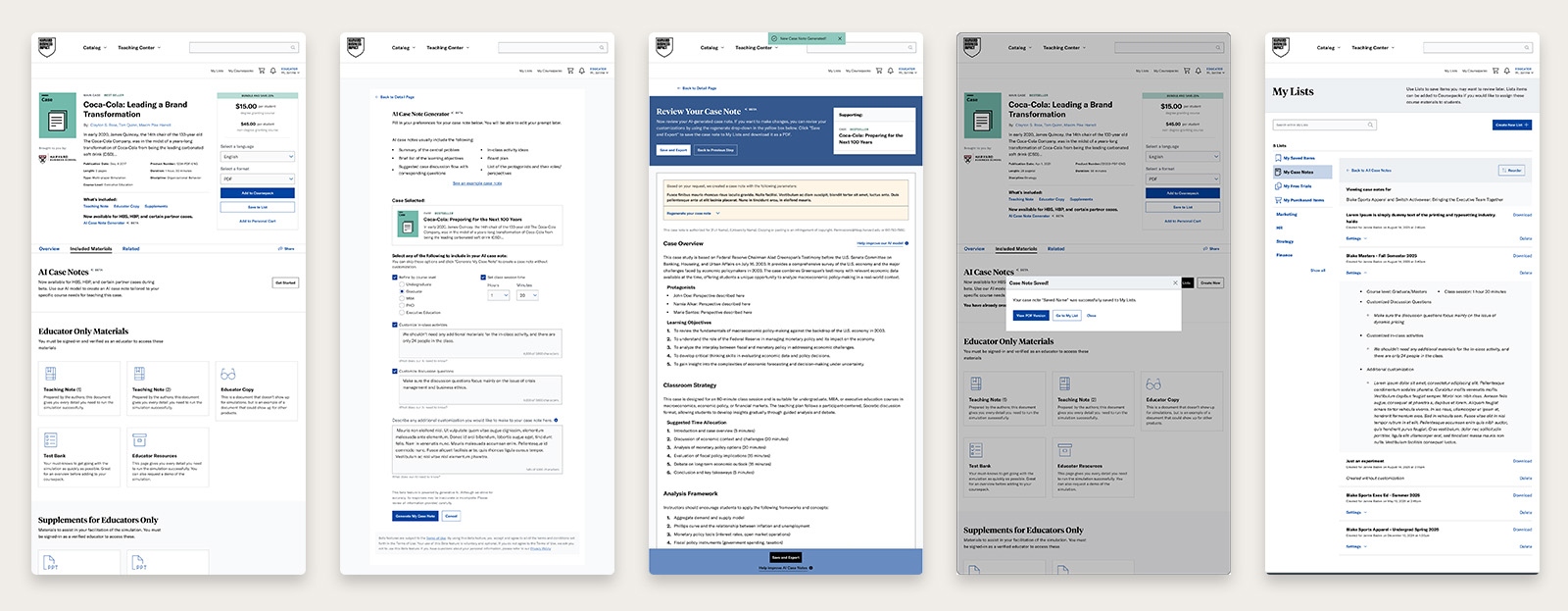
My research directly shaped the interface in ways that went beyond aesthetics. I worked closely with the Data/AI Engineering team to translate research findings into model guidance — explaining, for example, why the level of customization input mattered and what it would take for educators to trust a generated note enough to actually use it in class.
When 75.9% of generated notes in the beta ultimately included customization input from the user, that wasn't an accident — it was the result of designing an interface that made customization feel easy and clearly worthwhile.
The customization input design
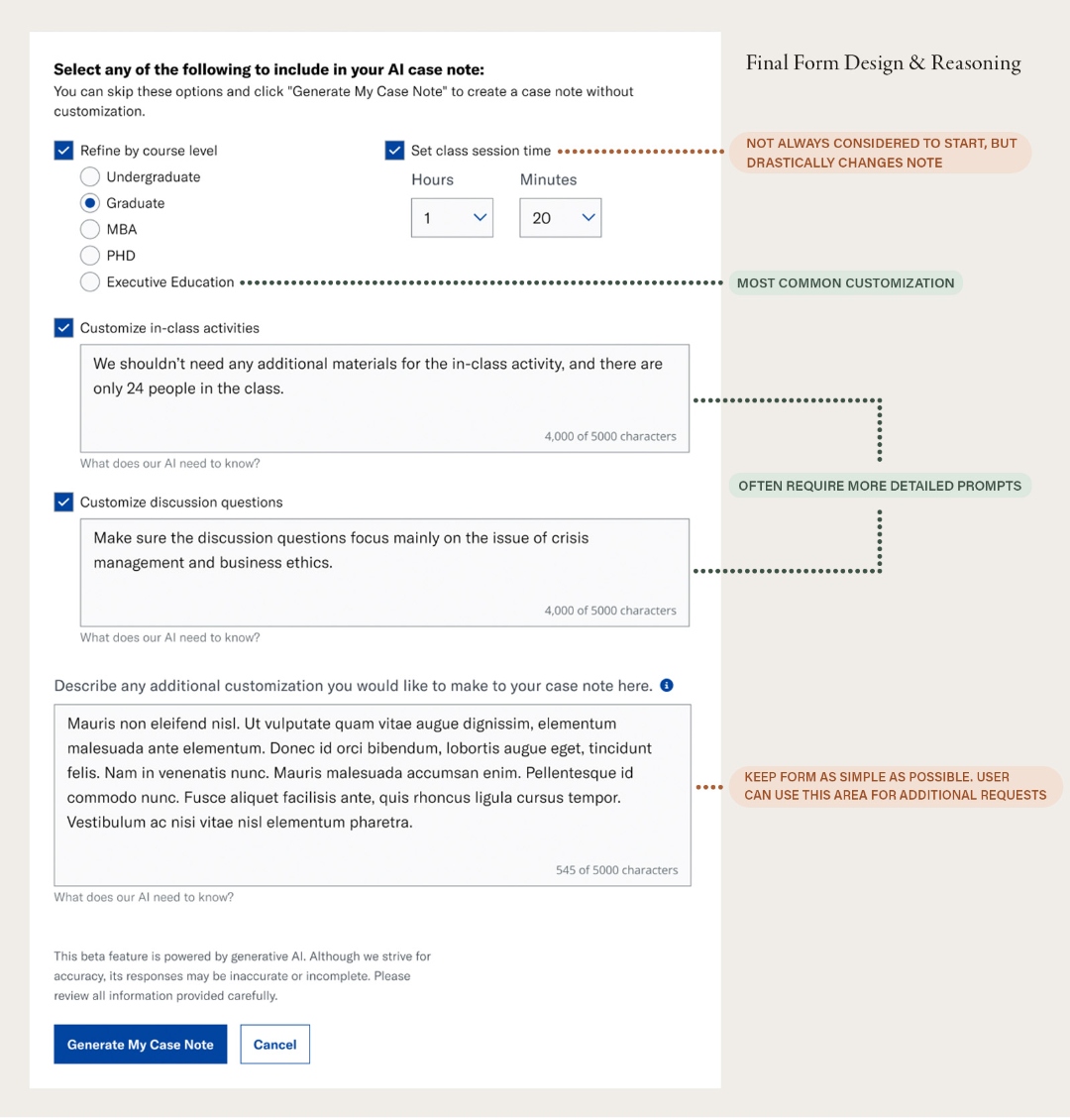
One of the most intentional design decisions was the customization input form. Research showed that educators most needed to adapt notes for course level, discussion goals, and their own teaching style. We included fields that mapped directly to those needs — and annotated them clearly in the UI so educators understood why we were asking.
The goal was to make customization feel like a 2-minute investment that would yield a significantly better output — not an obstacle to getting the note faster.
Testing & Iteration
A tight loop between research and engineering
The journey from early research to beta launch involved multiple rounds of user testing and AI model iteration. I helped facilitate testing sessions that gave us a clear view of where users trusted the output, where they hesitated, and where we needed to add guardrails or clearer guidance.
Each round of testing fed directly back into both the interface design and the model itself — a tight loop that's only possible when research and engineering are working closely together. I'm proud of how cross-functional this project was; it worked because everyone — Product, Engineering, Editorial, UX — was "in the room" for the right conversations.
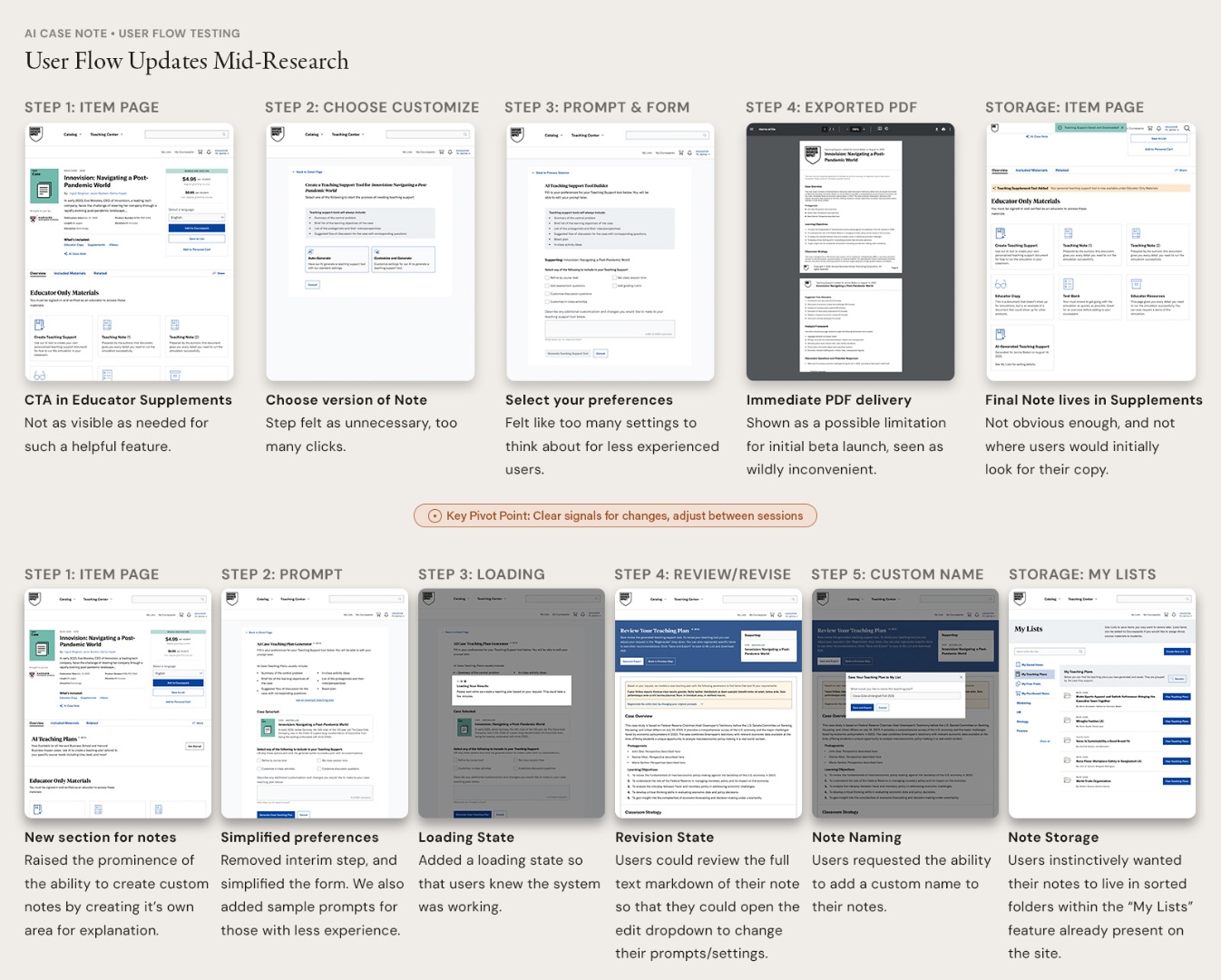
What each round changed
Early testing surfaced that educators weren't sure how much to trust AI output for something as important as classroom preparation. We responded by adding transparency signals — showing what sources the note drew from and making the "this is AI-generated" framing explicit rather than implicit. That change alone measurably increased user confidence in testing.
Outcomes
The beta launched in January 2026. The early data exceeded nearly every target we had set — and told us that educators were not just using the tool, but finding it genuinely valuable.
What I learned
This project reinforced something I believe deeply: when you do the research to understand the real workflow, the design decisions become clearer. Knowing that educators needed rigor, not convenience-theater, is what led to the customization design that drove engagement. Knowing that AI familiarity varied widely is what drove the clarity in the interface guidance. The research and the product outcomes were not separate tracks — they were the same track.
- Shaped the beta experience from early discovery through launch
- Co-led educator interviews and research synthesis that directly informed model requirements
- Designed the customization input experience — directly tied to the 75.9% customization engagement rate
- Cross-functional partner across Product, Data/AI Engineering, Editorial, and UX
- All five CSAT targets exceeded at launch